When you think of a French wedding, your mind likely drifts to rolling vineyards in Bordeaux, high-fashion attire, and an endless flow of Champagne. While the elegance is undeniable, French marriage culture is also home to some of the most eccentric, hilarious, and deeply symbolic rituals in the world.
Weird, Funny, and Interesting French Wedding Traditions: A Complete Guide to Customs and Etiquette
From hiding a chamber pot under the bed to the specific reason why the French throw sweets at newlyweds, these customs are designed to test the couple’s sense of humor and celebrate their community. Whether you are planning a traditional wedding in France or simply trying to understand French wedding etiquette as a guest, this guide explores the fascinating world of French wedding traditions.

The Foundation of French Marriage Culture
In France, a wedding isn’t just a one-hour ceremony; it is a marathon of social interactions and ancient rites. Unlike many Anglophone cultures where the focus is solely on the couple, a traditional French wedding is a communal affair where the “village” (or the extended family) plays an active, sometimes mischievous, role.
The Civil vs. Religious Split
It is important to understand that in France, a religious ceremony has no legal standing. Couples must first marry at the Mairie (Town Hall). Only after the civil ceremony is performed by the mayor can the couple proceed to a church. This often results in two distinct “looks” and two separate processions, creating a day that feels twice as momentous.
| Tradition Phase | Key Feature | Atmosphere |
| Civil Ceremony | Held at the Town Hall (Mairie) | Legal, formal, and mandatory |
| Religious Ceremony | Often at a local Catholic church | Emotional, traditional, and symbolic |
| Vin d’Honneur | Post-ceremony cocktail hour | Social, light, and celebratory |
| La Soirée | The dinner and dancing | High-energy, gourmet, and long |
Pre-Wedding Rituals: French Engagement Traditions
Before the “I do,” comes the fiançailles. French engagement traditions are surprisingly intimate. Historically, the groom’s family would visit the bride’s family for a formal request. Today, this has evolved into the repas de fiançailles, a celebratory dinner where the two families merge.
The Ring and the Promise
The French engagement ring is steeped in history. Influenced by ancient Egyptian and Greek beliefs, the ring is placed on the left ring finger. The Greeks believed a vein, the vena amoris (vein of love), ran directly from this finger to the heart. While original rings were often iron to symbolize strength, modern standards favor gold and precious stones.
Pro-Tip: If you are attending a French engagement party, French wedding traditions gifts usually lean toward high-quality wine or flowers for the host. Save the larger registry gifts for the actual wedding day.
Weird French Wedding Traditions: From Potty Humor to Superstition
France is a country of contradictions—sophisticated yet grounded in earthy, rural humor. Some of the weird French traditions associated with weddings might catch an outsider off guard.
1. La Soupe à l’Oignon (The Onion Soup)
As the sun begins to rise and the dancing winds down (often around 4:00 or 5:00 AM), a huge pot of French wedding food—specifically onion soup—is brought out. This is a practical tradition; the heavy, salty soup is designed to help guests recover from the Champagne and regain energy for the trek home.
2. Le Pot de Chambre (The Chamber Pot)
Perhaps the most famous of the weird French wedding traditions, this custom originated in the Aveyron region. Historically, after the couple escaped to their secret wedding-night location, the bridal party would hunt them down. Once found, the couple was forced to drink a concoction of chocolate, bananas, and Champagne out of a real chamber pot.
While it sounds unappetizing, it symbolized the transition from childhood to adulthood and was meant to give the couple “strength” for their new life together.
3. Throwing Sweets: Why did the French throw sweets at newlyweds?
You might be familiar with throwing rice, but throwing sweets on the wedding night (or as the couple exits the church) is a quintessentially French move. These sweets are usually dragées—sugared almonds.
-
Why? It symbolizes fertility, prosperity, and a “sweet” start to the marriage.
-
The Number Five: Tradition dictates giving guests five dragées to represent five wishes: health, wealth, happiness, longevity, and fertility.
The “Four Elements” and Old French Wedding Traditions
Many old French wedding traditions share roots with English customs but carry a unique Gallic flair. The “Something Old, Something New” poem is widely followed, but with specific French interpretations.
-
Something Old: Usually a family heirloom, representing the bride’s life before the union.
-
Something New: Typically the wedding dress, symbolizing the future and success.
-
Something Borrowed: An item from a successfully married friend to “transfer” their good luck.
-
Something Blue: A discreet ribbon or garter, representing fidelity and purity.
The Wedding Procession (Le Cortège)
In a traditional wedding in France, the groom walks his mother down the aisle, followed by the wedding party. The bride and her father are the last to enter. During the walk to the church, it was once common for children to stretch white ribbons across the path, which the bride would cut to symbolize her ability to overcome obstacles.
French Wedding Food: A Gastronomic Marathon
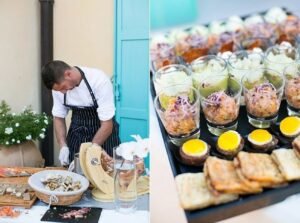
You cannot discuss weddings in France traditions without focusing on the menu. In French marriage culture, the meal is the entertainment. It is not uncommon for a French wedding dinner to last four to six hours.
The Traditional Menu Structure
-
Le Vin d’Honneur: A cocktail hour with Kir Royale and elaborate canapés.
-
The Starter: Often Foie Gras, scallops, or a delicate lobster salad.
-
The Main: Usually a slow-roasted meat like duck breast (magret de canard) or veal, served rare as per French wedding food standards.
-
Le Plateau de Fromages: A mandatory course of regional cheeses served with crusty baguettes.
-
The Dessert: The showstopper.
The Croquembouche vs. The Wedding Cake
Forget the tiered fruitcake. A traditional French wedding dessert is the Croquembouche—a towering cone of cream-filled choux pastry puffs bound together with threads of caramelized sugar.
| Food Item | Significance | When it’s Served |
| Foie Gras | Luxury and celebration | Starter |
| Trou Normand | A shot of Calvados to clear the palate | Between courses |
| Croquembouche | Wealth and abundance | Late evening |
| Onion Soup | Stamina and recovery | Sunrise |
French Wedding Etiquette: Tips for the Modern Guest
If you find yourself invited to a French reception, there are a few unwritten rules of French wedding etiquette you should follow to blend in.
-
Punctuality is Flexible: While you should be on time for the ceremony, the Vin d’Honneur is much more relaxed.
-
Dress Code: Think “effortless chic.” Avoid anything too flashy or casual. Men usually wear well-tailored suits, and women wear elegant day dresses.
-
The Seating Chart: Be prepared for a very strategic seating arrangement. The French take table conversation seriously, and you will likely be seated next to someone the couple thinks you will find interesting.
Pro-Tip: On my last trip to a wedding in Provence, I noticed that guests rarely leave before the cake is cut, which can be as late as 1:00 AM. Pace your drinking and save your energy for the dance floor!

Historical Customs: Why the Bride Stands on the Left
Have you ever wondered why the bride stands on the left of the groom? This old French wedding tradition dates back to the days of knights and sword-fighting. The groom kept his right hand free to draw his sword and fend off any rival suitors or “spirits” who might try to steal the bride during the French wedding ceremony. Today, it remains a charming nod to the groom’s role as a protector.
How to Incorporate French Traditions into a Modern Wedding
If you want to add a touch of “Joie de Vivre” to your own big day, follow these steps to blend france wedding traditions with modern sensibilities:
-
Host a Vin d’Honneur: Instead of a standard cocktail hour, create a dedicated 2-hour window after the ceremony for Champagne and light bites. This allows you to invite a larger circle of acquaintances who may not be staying for the formal dinner.
-
The Multi-Course Feast: Swap the buffet for a seated, four or five-course meal. Include a cheese course before the dessert to give your guests the authentic French experience.
-
The Dessert Tower: Choose a Croquembouche. It’s a visual masterpiece and much easier to serve than a traditional sliced cake.
-
The Party Favors: Give each guest a small, elegant box containing exactly five sugared almonds (dragées) to honor the five symbols of a happy life.
-
The Late-Night Recovery: Arrange for an onion soup station to appear at 2:00 AM. Your guests will thank you the next morning!
FAQ: Common Questions About French Wedding Customs
Why did the French throw sweets at newlyweds?
Historically, guests threw grains or sweets to represent fertility and abundance. Today, it is a celebratory gesture to wish the couple a “sweet” and prosperous life together.
What are some weird French wedding traditions?
The most famous is Le Pot de Chambre, where guests serve a mix of food and drink in a chamber pot to the couple on their wedding night. Another is the “toilet bowl” tradition where leftovers are placed in a toilet-shaped vessel for the couple to taste.
What is the typical French wedding food?
Expect a gourmet experience including Foie Gras, rare-cooked meats (like duck or beef), an extensive cheese board, and the Croquembouche pastry tower for dessert.
What should I give as a French wedding gift?
Most modern French couples use an online registry or a cagnotte (a honeymoon fund box at the reception). If giving a physical gift, focus on high-quality home goods or fine wine.
How long does a French wedding reception last?
A typical French reception starts in the afternoon and can easily last until 5:00 or 6:00 AM the following morning. It is a true test of endurance!
What is the significance of the 41st wedding anniversary in France?
Known as the “Iron Anniversary” (Noces de Fer), it symbolizes a love that is as strong and unbreakable as iron. It is a major milestone in french marriage culture.
What are French engagement traditions like?
They focus on the “Fiançailles,” which is a formal period of preparation. It often involves a dinner where the families meet and the exchange of a gold engagement ring.
What is a “Vin d’Honneur”?
It is the reception held immediately after the wedding ceremony. It is less formal than the dinner and usually features Champagne and hors d’oeuvres.
Are French Canadian wedding traditions different?
Yes, french canadian wedding traditions often blend French roots with North American customs, such as “The Sock Dance,” where older unmarried siblings dance in colorful socks to earn money for the couple.
Is the “Garter Toss” common in France?
While it has roots in medieval Europe, the garter toss is less common in modern urban French weddings but still appears in more traditional, rural celebrations.
Why do the French honk their car horns after a wedding?
This is part of the “procession.” It dates back to the Middle Ages when weddings had to be announced as loudly as possible to ensure the union was public and legal.
Pingback: Dominican Republic Wedding Traditions: What Really Happens, What It Costs, and What Guests Should Expect | SeaFranceHolidays